
Understanding Property Titles in Cambodia
Cambodia’s real estate market offers a wide range of opportunities for homebuyers and investors. However, despite the growing number of real estate agents and property services in…
ค้นหาตามอสังหาฯ
ค้นหาตามพื้นที่
ค้นหาตามพื้นที่
Cambodia’s real estate market offers a wide range of opportunities for homebuyers and investors. However, despite the growing number of real estate agents and property services in…
Cambodia’s real estate market offers a wide range of opportunities for homebuyers and investors. However, despite the growing number of real estate agents and property services in the country, clear, comprehensive explanations of Cambodia’s property title system can still be difficult to find.
A property title is a legal document or record that helps establish a person's rights to a property. Understanding the type of title attached to a property is essential because it affects ownership rights, property transfers and the legal checks buyers should complete before making a purchase.
In Cambodia, buyers commonly encounter three main property arrangements: soft title, hard title and leasehold. Each offers different rights and levels of legal protection. Strata title is also important for condominium buyers, as it allows ownership of an individual unit within a co-owned building.
Why does Cambodia have these different arrangements? The country's property system has evolved through changes in land laws, registration processes and property development. As a result, buyers may encounter different forms of documentation and ownership arrangements depending on the property.
This guide explains the differences between soft title, hard title and leasehold in Cambodia, explores how strata title fits into the system, and outlines what buyers should verify before purchasing property.
Cambodia's land registration system was severely disrupted during the Khmer Rouge period, when many land records were lost. Private ownership was reintroduced in 1989, followed by the Land Law of 2001, which established the legal framework for modern land ownership.
Systematic land registration began in 2002, helping expand formal land registration across the country. Today, buyers may encounter both locally documented property commonly associated with soft titles and formally registered property with hard titles.
A soft title is a form of property documentation commonly associated with local administrative records, often involving the commune or district authorities. It is widely encountered in Cambodia, particularly for land and residential properties.
Soft titles can document a transaction or possession claim, but they do not provide the same level of registered ownership as a hard title. Their legal strength and the risks involved depend on the property's history, location, supporting documents and whether there are competing claims.
A soft title should not automatically be considered invalid or unsafe. However, buyers should understand that it is not equivalent to a hard title and should seek independent legal advice before proceeding.
.png.png)
A hard title is a certificate of ownership registered through Cambodia's formal cadastral system. It provides official evidence of ownership and records the property and its registered owner in the national land registration system.
Hard titles are commonly associated with land, houses and other eligible properties. To understand their importance today, it helps to look briefly at how Cambodia's land registration system developed.
Before the introduction of modern systematic land registration, Cambodia used earlier forms of land documentation, including what is commonly known as the chicken feather title (ប្លង់ស្លាបមាន់), named after the feather symbol associated with the document. These older documents were part of Cambodia's earlier land administration system, and their legal status can vary depending on the document and the property's registration history.
Cambodia's land registration system was severely disrupted during the Khmer Rouge period (1975–1979), when many land records were lost and private property ownership was abolished. Private ownership was reintroduced in 1989, followed by land law reforms that helped establish the framework for modern property ownership.
A major milestone came in 2002, when Cambodia began implementing the Land Management and Administration Project (LMAP). The project supported systematic land registration, land surveying and cadastral mapping, helping establish a more formal process for recording ownership and issuing hard titles.
Today, hard titles provide formal evidence of registered ownership. However, older land documents should not automatically be treated as equivalent to modern hard titles. Buyers should verify the specific document and the property's current registration status with the relevant authorities.
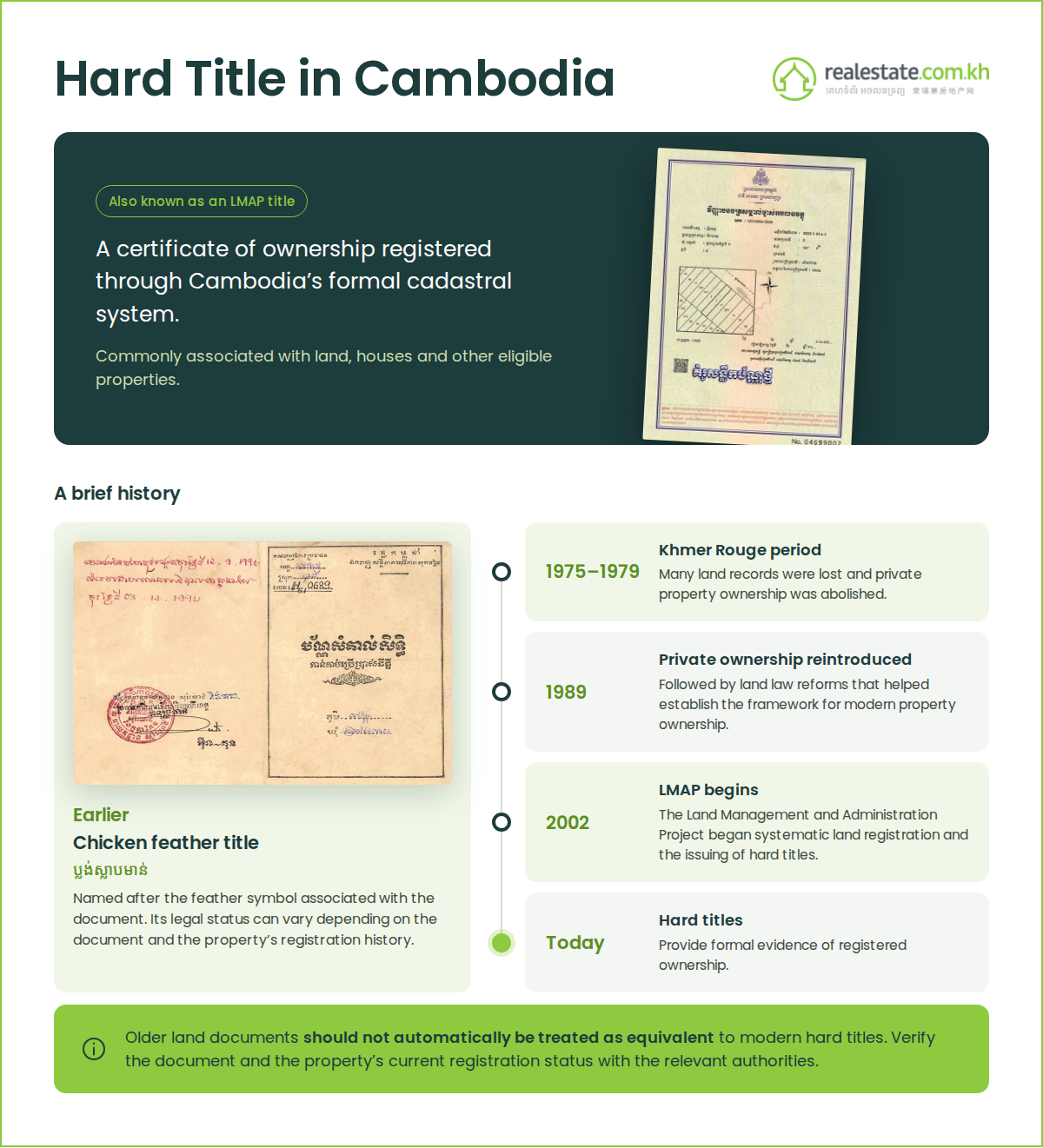
An LMAP title is a type of hard title associated with systematic land registration under the Land Management and Administration Project, which began in 2002.
Through systematic registration, authorities survey and map properties within designated areas before recording ownership in the cadastral system. An LMAP title is therefore associated with the formal registration process that helped expand registered property ownership in Cambodia.
When buying a house in a borey or gated residential development, buyers should check whether the individual property already has its own title or remains under a larger development or master title.
The distinction matters because the process and timeline for obtaining an individual title may vary. Before paying a deposit, ask the developer or seller for written confirmation of the property's title status, the documents available and the expected timeline for transfer or issuance.
READ MORE: What is the Hard Title Transfer Process in Cambodia?
A strata title in Cambodia is a type of hard title that allows a buyer to own an individual unit within a co-owned building, such as a condominium. It provides legal evidence of ownership of the unit, along with rights and responsibilities relating to shared areas of the building.
Strata titles are particularly important for condominium buyers because they establish individual unit ownership rather than ownership of the entire building or land.
Yes. Under Cambodia's foreign ownership laws, eligible foreign buyers can own qualifying condominium units under a strata title. However, foreign ownership is subject to restrictions, including a general requirement that foreign owners cannot own units on the ground floor or below, and that foreign ownership must not exceed 70% of the privately owned units in a co-owned building.
Foreign buyers should verify that the condominium qualifies for foreign ownership before purchasing.
Before buying a condominium in Cambodia, buyers should check:
If the strata title has not yet been issued, buyers should confirm the property's current legal status and ensure that the sale agreement clearly explains the developer's obligations and expected title issuance timeline.
A leasehold title in Cambodia gives an individual or company the legal right to use and occupy a property for an agreed period under a lease agreement. Unlike a hard title, which records ownership of the property or land, a leasehold establishes the right to use the property for the duration of the lease.
Leasehold is a recognised property arrangement in Cambodia and can be suitable for residential, commercial and investment purposes. When properly structured and legally protected, a leasehold can provide buyers with clear rights and security for the agreed lease term.
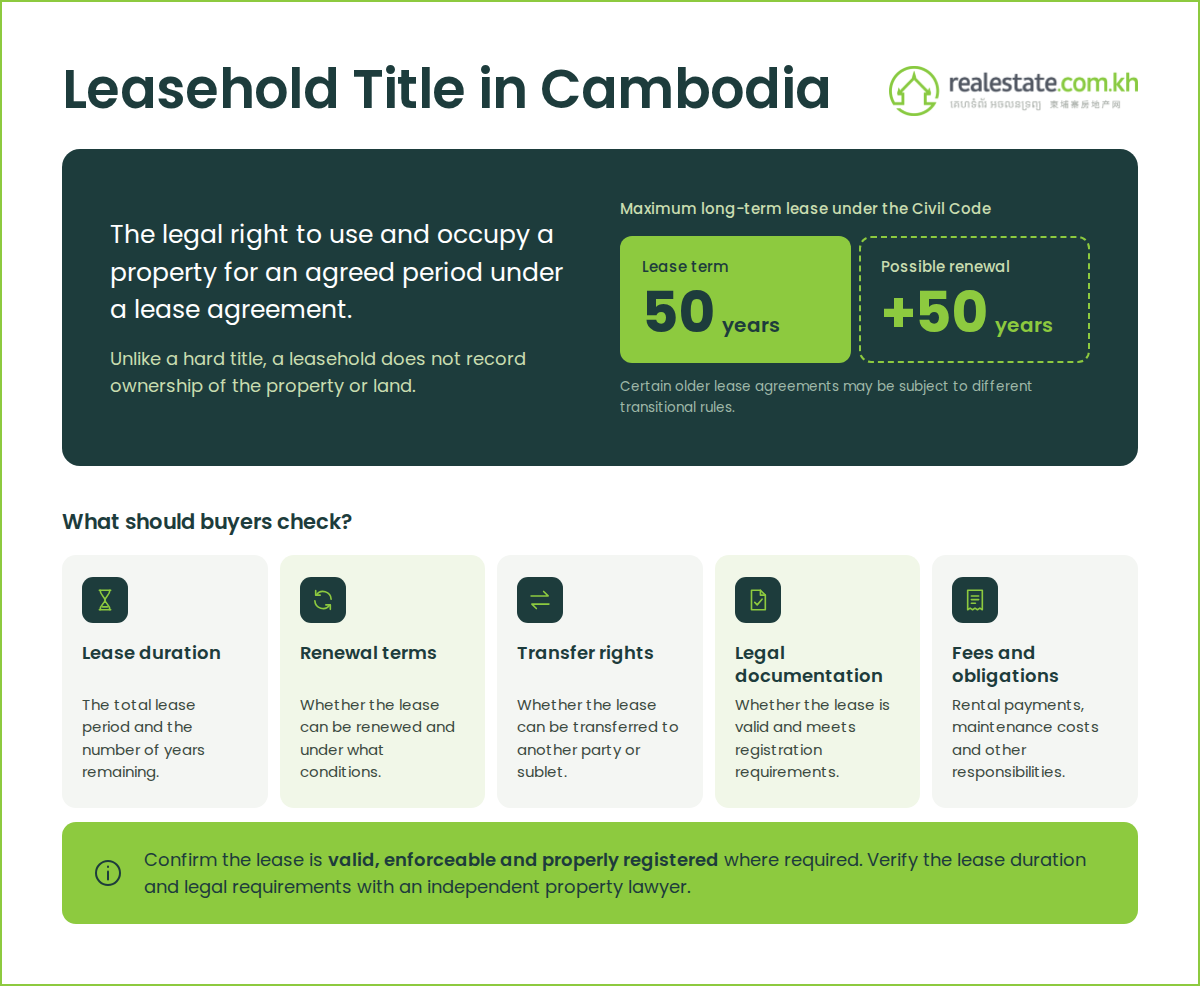
Buyers can identify a leasehold by checking the lease agreement and relevant property documents. These documents should specify the lease duration, the parties involved and the rights granted to the leaseholder.
In particular, look for the section stating the lease start date and end date, which indicates how long the property is leased for. Depending on the type of lease and applicable registration requirements, the lease term and related information may also appear in the relevant registered documents.
Before purchasing a leasehold property, buyers should verify the documents and confirm that the lease is valid, enforceable and properly registered where required.
Before purchasing a leasehold property, buyers should check:
Cambodia's Civil Code provides for long-term leases of up to 50 years, with the possibility of renewal for a further term of up to 50 years. Certain older lease agreements may be subject to different transitional rules. Buyers should verify the lease duration and applicable legal requirements with an independent property lawyer.
READ MORE: What is Freehold and Leasehold Ownership in Cambodia?
Yes, foreigners can own property in Cambodia and are only restricted on direct foreign ownership of land. Foreign individuals generally cannot own land in their own names, although other lawful arrangements may be available depending on the circumstances.
Eligible foreign buyers may own qualifying private units in co-owned buildings under Cambodia's foreign ownership framework. Such ownership is subject to legal conditions, including restrictions on the location of units within a building and the overall proportion of foreign-owned units.
Leasehold arrangements may provide another option for foreign individuals or businesses seeking the right to use property, but a lease does not grant land ownership.
Foreign buyers should not rely solely on a developer's or seller's explanation of ownership rights. They should obtain independent legal advice to confirm that the proposed arrangement complies with Cambodian law and that the documents provide the rights being advertised.
Important: These are not four legally equivalent categories. Soft and hard titles describe different forms of property documentation and registration; strata title is a form of registered ownership for an individual unit; leasehold is a right to use property under a lease.
READ MORE: What is the difference between Hard Titles and Soft Titles in Cambodia?
Property transactions in Cambodia may involve transfer tax, registration fees, legal fees and other transaction costs. The total amount depends on the property, the transaction and the applicable rules.
The commonly cited property transfer tax rate is 4%, generally calculated on the applicable tax base determined by the tax authorities. The taxable value may differ from the price agreed between the buyer and seller.
Cambodia has also introduced tax incentives for certain property transfers at different times. As these measures may have eligibility conditions and expiry dates, buyers should confirm the current rules with the General Department of Taxation or a qualified tax professional before budgeting for a purchase.
Before signing a sale agreement, ask for a written breakdown of the expected costs and clarify which expenses will be paid by the buyer and which will be paid by the seller.
Read more about guide to property taxes in Cambodia
Choosing the right property involves more than location and price. Understanding the title, verifying the seller's rights and reviewing the legal documents can help you make a more informed decision.
Explore properties for sale across Cambodia on Realestate.com.kh, or contact the Realestate.com.kh team for assistance navigating the local property market.
Cambodia has three main types of property title: soft titles, hard titles and leasehold. A soft title is a possession document issued or certified by local authorities at commune/sangkat or district level. A hard title is ownership registered in the national cadastral system under the Ministry of Land Management, Urban Planning and Construction. Hard titles include LMAP titles and strata titles for condominium units. A leasehold gives the right to use a property for an agreed period, but it does not grant ownership of the land.
For land in Cambodia, a hard title is generally the best and strongest proof of ownership, because it is registered in the national cadastral system. For condominium units, the equivalent is a strata title, which is a form of hard title. Whatever the title type, buyers should verify it with the relevant land office before purchasing.
A hard title confirms ownership registered in Cambodia’s national cadastral system. A soft title records possession or a property claim at the local level. Because a hard title is registered nationally, it generally provides stronger legal evidence of ownership and is easier to sell or use as loan collateral.
To check a hard title, request a title verification at the provincial or municipal land management office (cadastral office) where the property is located. The check should confirm the registered owner and plot details, and show any mortgages, disputes or restrictions recorded against the title. For a soft title, check with the local commune/sangkat and district offices. A lawyer can carry out these checks on the buyer’s behalf.
Soft titles are widely used and recognized as evidence of possession in Cambodia. However, they do not carry the same legal weight as a registered hard title. A soft title’s standing depends on its supporting documents, the property’s history and the circumstances. Buyers should get independent legal advice and verify the seller’s rights before purchasing.
Yes. An LMAP title is a type of hard title, issued through systematic land registration under the Land Management and Administration Project. As with any title, buyers should verify that the specific document is authentic and that its registration details are current.
Some soft titles can be converted to hard titles. Eligibility depends on the property’s location, its documentation and the applicable registration procedures. Buyers should confirm eligibility with the relevant land office before relying on a seller’s promise of conversion.
Foreigners cannot directly own land in Cambodia in their own names. They can, however, invest in land through legally permitted arrangements such as trust services in Cambodia, which must comply with Cambodian law and regulatory requirements. Foreigners can also own eligible condominium units under Cambodia’s strata title system, subject to legal restrictions.
Yes, foreigners can own a condominium in Cambodia under the strata title system. Foreign buyers may own private units above the ground floor in qualifying co-owned buildings, and foreign ownership is capped at 70% of the units in a building. Buyers should confirm that the specific unit and ownership arrangement qualify.
A strata title is registered ownership of an individual unit in a co-owned building. A leasehold is the right to use a property for an agreed period without owning it. A leasehold can be a contractual or a registered right, but it never grants ownership of the land, and use of the property returns to the owner when the lease ends.
Property transfer tax in Cambodia is commonly 4%, applied to the property’s taxable value. Exemptions or reductions may apply in some cases. Buyers should confirm the current rate, tax base and any incentives with the General Department of Taxation or a qualified tax professional before completing a transaction.
ตัวเลขเหล่านี้มาจากประกาศจริงที่อัปเดตทุกวัน เริ่มค้นหาได้ที่นี่
ค้นหาบ้านทั้งหมด › What is Freehold and Leasehold Ownership in Cambodia?
 Guide to Retiring in Cambodia in 2026
 Location Comparison: Buying in CBD vs Suburbs in Phnom Penh